

Send us your enquiry along with your collet drawings, and we will quote and supply your requirements exactly as per your specification. We maintain precision in runout, dimensions, and all critical technical details.
Email your drawings to infotoolsengg@gmail.com. With years of experience handling thousands of special collet variants, we understand a wide range of application requirements. Feel free to contact us anytime — we are always here to help.
Workholding Collets
(Outside Diameter Holding Type)
Stationary Type Collets
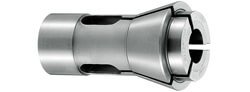
Stationary type collets are used for machining applications that require accurate axial positioning of the workpiece.
Because the collet itself does not move, there is no axial displacement during clamping. As a result, they are especially suitable for secondary operations that demand precise alignment.
Stationary type collets can also be used as tool-holding collets when used with a nose cap.
Draw Back Type Collets
Draw back type collets pull the collet into the chuck and grip the workpiece using the rear screw mechanism. They are commonly used for primary machining applications such as NC lathes.
These collets offer high precision and strong rigidity compared to stationary type collets.
However, axial positioning is generally less stable than with stationary type collets.

Push Type Collets
Push type collets press the collet against the nose cap while holding the workpiece. As a result, the workpiece moves in the axial direction during clamping.
They are not generally selected for high-precision concentricity, but they are useful where clearance from cutting tools is important.

Tan Line Collets
Tan line collets are mainly used in hobbing machines, such as Gleason machines, and are essential for machining automotive differential gears.
These collets use a dual-taper structure and are suitable for clamping long workpieces securely.
Workholding Collets
(Inside Diameter Holding Type)
Double Taper Expansion Collets
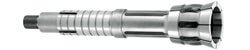
Double taper expansion collets are the standard expansion type for inside-diameter clamping.
The collet expands when the central section is drawn by the drawbar, allowing the workpiece to be clamped securely.
Because flexing slots are present on both the front and rear sides, the collet opens in a parallel manner.

Single Taper Expansion Collets
Single taper expansion collets are commonly used in primary machining applications such as NC lathes.
The collet expands when the central section is drawn by the drawbar and secures the workpiece with parallel opening action.
Compared with double taper expansion collets, they generally offer higher precision.
Flange Type Expansion Collets
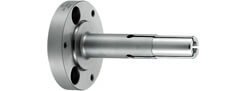
These are expansion collets with a flange. The collet expands when the central section is drawn by the drawbar and grips the workpiece securely.
Since one side includes a flange, the bore may not open perfectly in parallel when the collet is fully open in its free state.
They provide a wider clamping range in the free state, which makes workpiece insertion easier.
Expansion Disk
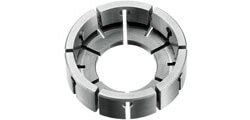
An expansion disk is used in gear cutting machines along with tan line collets, and it is essential for machining automotive differential gears.
It has a face-to-face two-plate structure that expands the outside diameter by compression and clamps the workpiece securely.

Carriage Collet Chucks
Feed Fingers
Feed fingers are used as collets for supplying workpieces in NC lathes and multi-spindle lathes with automatic bar feeders.
They are also known as "pusher" collets because they push the bar material forward.
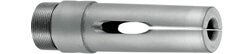
Finger Collets
Finger collets hold a workpiece using only the spring force of the collet itself, so care must be taken when clamping heavier components.
They are economical because no separate opening-and-closing mechanism is required.

Tool Holding Collets
Collets for Tooling Systems
Collets for tooling systems are mainly used for holding cutting tools and are available in single taper and double taper forms.
Because flexing slots are present on both the front and rear sides, they can hold tools securely even when the outside diameter varies slightly.
They are generally not suitable for workpiece holding because they offer a smaller clamping range than draw back type collets.

Basic Technical Information on Collets
What Are Spring Collets?
Spring collets are precision workholding tools used to fix a workpiece during machining or to hold cutting tools. They are used as part of machine-tool and automation systems.
A spring collet works by opening and closing inside a workholding device to clamp and release the workpiece securely. Different applications require different sizes, clamping methods, and clamping forces.
Compared with scroll chucks, which use three or four jaws, spring collets clamp the workpiece uniformly around its surface. This helps distribute pressure more evenly and reduces the risk of surface damage.
Part Names and Functions
Stationary and draw back designs are two of the most common spring collet configurations. The correct taper angle and taper type must be specified clearly to avoid mismatch.
Please inform us whether your requirement is for double taper or single taper collets.
Selection Guide
| Use | Type | Runout Accuracy | Axial Accuracy | Clamping Force |
|---|---|---|---|---|
| Workholding | Stationary type collets | Good | High | Good |
| Workholding | Draw back type collets | High | Moderate | High |
| Workholding | Push type collets | Moderate | Moderate | Moderate |
| Workholding | Tan line collets | High | Moderate | Moderate |
| Inside diameter holding | Double taper expansion collets | Moderate | Moderate | Moderate |
| Inside diameter holding | Single taper expansion collets | High | Moderate | Moderate |
| Inside diameter holding | Flange type expansion collets | Moderate | High | Moderate |
| Inside diameter holding | Expansion disk | Moderate | Moderate | High |
| Tool holding | Collets for tooling systems | High | Moderate | High |
| Carriage collet chucks | Feed fingers / Finger collets | Low | Low | Low |
* The table above shows a typical standard. Please contact us for detailed specifications of spring collets or workholding devices using spring collets.