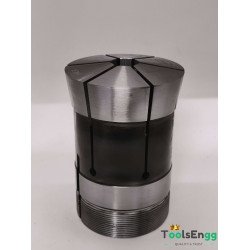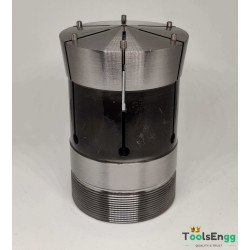
22J Collets: Design, Specifications, and Machining Applications
In high-precision manufacturing, selecting the appropriate workholding system directly impacts part quality, cycle time, and tool life. While the 5C collet system remains an industry standard for light-duty turning and grinding, modern CNC turning centers and production shops often require larger bar capacities without sacrificing clamping force or rotational stability. The 22J collet system bridges this gap effectively.
This article covers the mechanical design, dimensional specifications, operational parameters, and practical advantages of the 22J collet series in industrial machining setups.
1. What is a 22J Collet?
A 22J collet is a dead-length or pull-back spring collet designed primarily for workpiece holding on CNC lathes, automatic turning centers, and heavy-duty fixture blocks. It provides exceptional clamping force, precise concentricity, and minimal radial runout across round, hexagonal, and square bar stock.
The "J" series of collets was engineered to handle larger bar diameters than standard spindle collets while maintaining a compact external chuck envelope. The 22J size variant is rated for a maximum round bar capacity of 2.250 inches (2-1/4" / ~57 mm).
2. Technical Specifications & Dimensions
Understanding the physical profile of a 22J collet is essential for custom fixture design, spindle adaptation, and drawbar force calculation.
| Parameter | Specification (Imperial) | Specification (Metric) |
|---|---|---|
| Max Round Bar Capacity | 2.250 in | 57.15 mm |
| Max Hex Capacity | 1.937 in (1-15/16") | 49.21 mm |
| Max Square Capacity | 1.500 in (1-1/2") | 38.10 mm |
| Body Outer Diameter (OD) | ~2.500 in | ~63.50 mm |
| Overall Length (OAL) | ~4" in | ~101.6 mm |
| Actuation Style | Pull-back or Dead-length | Pull-back or Dead-length |
| Standard TIR Accuracy | ≤ 0.0005 in | ≤ 0.012 mm |
| Precision Class TIR | ≤ 0.0002 in | ≤ 0.005 mm |
Note: Minor dimensional variances exist between manufacturers (e.g., ToolsEngg, Hardinge, Lyndex-Nikken, Lexair, Royal Products), but mounting taper angles and key geometries conform to standard 22J chuck interfaces.
3. Kinematics and Clamping Mechanics
22J collets operate via a tapered cone collapse mechanism:
- Drawbar Tension: The lathe's hydraulic or pneumatic cylinder pulls back on the drawbar threaded into the rear of the collet (or pushes an external sleeve over the collet taper in a dead-length setup).
- Radial Collapse: As the external taper of the collet contacts the internal spindle/chuck taper, linear axial force converts into uniform radial clamping pressure along the collet's keyways.
- Friction Grip: The multi-slot flexible leaf structure collapses evenly onto the workpiece surface for maximum contact area.
Key Mechanical Advantages
- High Radial Clamping Force: The substantial contact surface area of the 22J taper generates significantly higher holding torque compared to 5C or 16C collets.
- Centrifugal Resistance: Unlike standard 3-jaw chucks whose jaw mass causes grip force loss at elevated spindle speeds, 22J collets maintain holding force at high RPM due to low mass and symmetrical balance.
- Reduced Part Distortion: The circumferential pressure contact minimizes thin-walled tube deformation compared to 3-point jaw contact.
4. Workholding System Comparison
Selecting between collet series comes down to stock size, clearance, and force requirements:
| Workholding System | Max Round Bar | Primary Application | Key Strength |
|---|---|---|---|
| 5C Collet | 1.062 in (27 mm) | Light Lathes, Mill Indexers | Massive accessory ecosystem, low cost |
| 16C Collet | 1.625 in (41 mm) | Medium CNC Turning Centers | Direct fit for many A2-5/A2-6 spindles |
| 22J Collet | 2.250 in (57 mm) | Heavy CNC Turning & Bar Feeding | High torque & 2.25" capacity in compact body |
| 3-Jaw Chuck | Spindle Bore Dependent | Large Forgings & Castings | Flexible size range without collet changes |
- Tool Clearance: The compact nose profile allows turning tools and live tooling to operate much closer to the main spindle without collision hazards.
- High-Speed Balance: Eliminates chuck vibration during high-RPM bar-feeding operations, improving overall surface finish.
- Rapid Changeovers: Changing collets for different bar stock sizes takes a fraction of the time needed to re-bore or swap soft jaws.
5. Maintenance and Tooling Best Practices
- Strict Grip Ranges: Spring collets like the 22J are engineered to grip stock within ± 0.005 in (± 0.13 mm) of their nominal size. Forcing oversized or undersized stock can permanently spring the body.
- Taper Cleanliness: Always clean the mating tapers of the chuck body and collet during size changes. Fine swarf or metal chips trapped in the taper introduce unwanted runout and wear.
- Actuator Pressure Calibration: Set hydraulic actuator pressure according to material wall thickness. Over-pressurizing can crush thin-walled tubing, while under-pressurizing can cause work axial pushback during heavy roughing cuts.
- Emergency Collet Preparation: When machining custom sizes into soft 22J emergency collets, ensure the collet is clamped onto an internal plug under actual tension while boring.